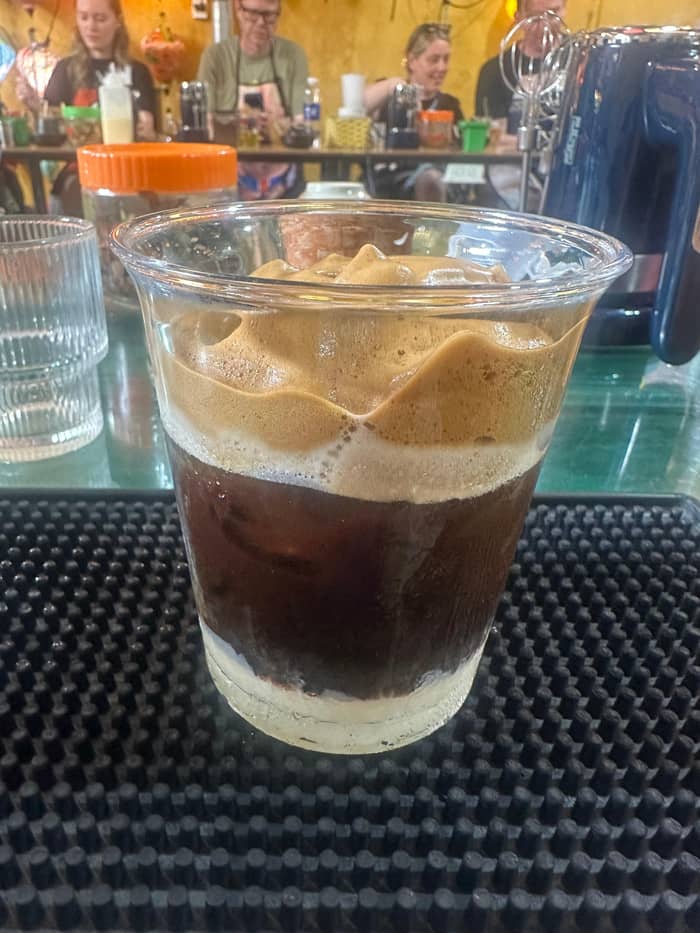
Hoi An
Hoi An coffee class
Styles in a group
- Length2 hours
- Reviews5,442
- Taught inEnglish, Vietnamese
Guides
Language
Currency
See availability$14 and up · free cancelInteractive to-do list
9-item checklist
Mark each item when done. Progress is stored on this device.
0 / 9 ready
You are ready. Choose your start time for the class, and the rest is settled.
Secure your spotEverything you need to brew a glass the way Vietnamese cafes do, from the filter and the grind to the milk, the slow drip and famous upgrades to try next.
Editorial team, vietnamesecoffeeclass.click · Updated November 16, 2026 · Takes 8 min
Overview
A hot Vietnamese coffee recipe needs very little equipment. The centerpiece is the phin, a compact metal drip filter that, as the national tourism authority puts it, runs on gravity and perches on the glass like a crown in miniature.1 The authority also points out that souvenir phins exist in sizes that sit right on a cup, which makes one easy to carry home.10 You also need a heatproof glass or cup that the phin can rest on, and a kettle.
For the coffee itself, buy dark-roasted robusta in a coarse grind. The authority's drip diagram shows coarse robusta grounds, and another of its features says butter or cocoa in the roast gives a rich, nutty smell.3,2 Vietnamese coffee beans are usually roasted in butter. Ask a cafe or a shop for the bag they use for the phin, and check that it is ground coarse, because a powder-fine grind clogs the filter.11
The last ingredient is sweet. The classic glass uses sweetened condensed milk, which, the authority explains, locals adopted when fresh milk was hard to find and pricey in tropical Indochina.12 Keep ice, a long spoon and, if you plan to serve it cold, a tall glass nearby. If you are making a hot cup, a small cup is enough. Nothing else is essential, which is the charm of the method.
Same brew, new tricks
| Drink | What goes in | The finish |
|---|---|---|
| Iced milk coffee | Condensed milk | Crushed ice, stirred6,13 |
| Bạc xỉu | More milk, less coffee | Crushed ice15 |
| Egg coffee | Yolk, sugar, condensed milk | Foam on top7 |
| Salt coffee | Salted cream condensed milk | Layer over the brew8 |
| Coconut coffee | Coconut, fresh and condensed milk | Spooned into a glass9 |
| Yoghurt coffee | Yoghurt, condensed milk, ice | Sour and sweet16 |
Ingredients as the national tourism authority lists them.6
Start with the milk, which sits in the bottom of the glass. For the classic cà phê sữa đá a generous spoonful of sweetened condensed milk goes into the glass first, and the phin brew drips onto it.6 Set the phin on the glass and spoon the grounds into the filter in an even layer, enough to cover the base. Settle the grounds with the pressing disc, a gentle press, rather than packing it down hard.
Then add the hot water. On the tourism authority's drip diagram the water reads 90°C to 95°C over coarse robusta grounds, though a longer feature speaks of boiling water.3,2 Since both a range and boiling water are given, let a freshly boiled kettle settle for a few moments, then pour a little over the grounds to wet them and add the rest after they have had a short while to swell and soften.
Now wait, and resist the urge to speed it up. Gravity and patience do all the work, the authority stresses, and the waiting counts as part of the enjoyment.4,5 The authority sees in the phin a lesson in patience.14 When the last drip falls, lift the phin off the glass, stir the coffee into the milk and, for a cold drink, pour it over a tall glass of crushed ice, stirring with a long spoon.13
Class lengths
Durations as the listings give them; the Hanoi workshop with salt coffee runs 3 hours, the Hoi An and Da Lat classes 2 hours and the Saigon beginner session 1.5 hours.
How much coffee for Vietnamese coffee is the most common question, and no official source gives a gram figure. The tourism authority's description is qualitative: a phin of coarse grounds, hot water, a slow drip, and a thick, syrupy result with notes of dark chocolate and nuts.17 The best guide is the brew itself. If the cup tastes thin, add more grounds next time; if the drip is very slow or stops, use fewer grounds or a coarser grind.
Strength is easier to adjust than to calculate. Black coffee is an acquired taste, the authority says, and bitterness is the reason many people sweeten it.18 A shorter drip with more milk gives a mild glass, and a longer drip with little milk gives a bold one. Vietnamese roasters use robusta, which the US International Trade Commission says has a higher caffeine content than arabica, so go lightly if you are sensitive.19
Cups and glasses vary, so measure by eye on the first try and keep a note of what you liked. A class is the quickest way to calibrate: our Hoi An class runs about 2 hours and lets you make several styles, so you leave knowing roughly what proportion tastes right to you. At home, repeat the same quantity several times and change one thing at a time, such as the grind, the milk or the length of the drip.
First brew
Pick what you like and a first recipe follows.
If I want the classic
Iced milk coffee
If I find coffee too bitter
Bạc xỉu
It uses more milk and less coffee.15
If I want dessert
Egg coffee
Whipped yolk foam crowns the coffee.7
If I want something cooling
Coconut coffee
Coconut, fresh and condensed milk blended with the drip.9
If I want it fast
Not this method
The phin relies on gravity and patience.4
Learn the real thing
Hoi An
Styles in a group
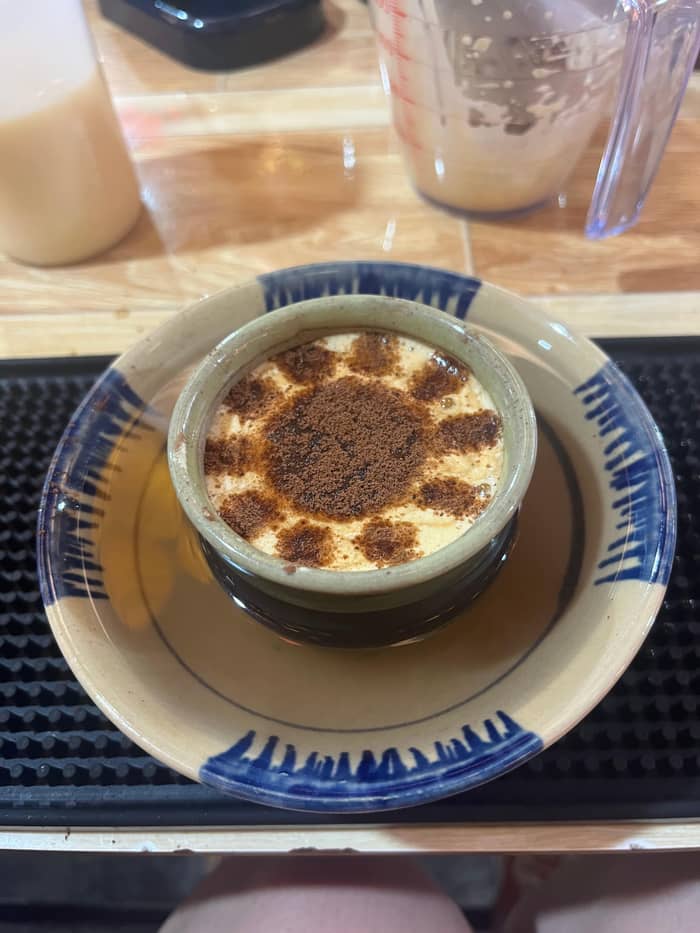
Hanoi egg
Make your own egg coffee
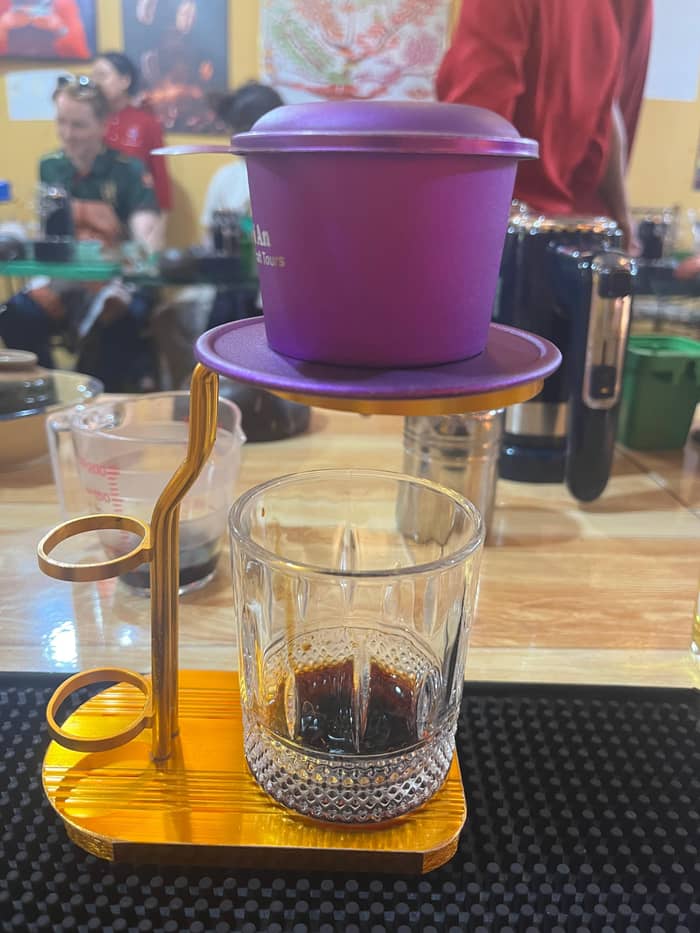
Saigon
Phin, bạc xỉu, salt coffee
How does Vietnamese coffee work? It is simpler than it looks. The authority sets the phin against Italian espresso: no high pressure here, only gravity and patience.4 Hot water sits among the grounds, seeps down through the perforated plate and falls into the glass drop by drop. There is no pump, no steam and no button to press, and the authority says the brew is steeped rather than forced.2
The slow contact gives a concentrated cup. The authority's description of the result is bold, chocolatey and full of caffeine kick.20 Keep the grind coarse, since water has to find its way down through the bed unaided, and a fine powder tends to stall the drip. A gently pressed, level layer lets the water drain evenly across the plate, and the brew then fills the glass at a steady pace without any attention from you.
Because the process is passive, it suits a morning routine. Set up the filter, put the kettle on and leave the coffee to drip while you get on with something else. The authority says the drip encourages pause, conversation and connection, and describes it as slow and unhurried.21 That idea is a good reason to stay close by and pay attention, watching the last drops fall before you stir.
Classes
Set your party and compare four workshops.
Compare all 4 options
Set your party and compare four workshops.
≈
View≈
View≈
View≈
ViewStarting prices as on the booking platform, converted at the ECB reference rate. You see the exact price at booking.
From kettle to glass
Set up
Put sweetened condensed milk in the bottom of the glass.6
Place
Sit the metal filter on the glass like a small crown.1
Fill
Spoon in dark-roasted robusta grounds and level them.2
Pour
Add water at 90°C to 95°C and let the grounds wet through.3
Wait
Serve
Stir the milk in and pour over crushed ice if you like.13
Iced milk coffee is the easiest upgrade. Tip the finished sweet brew onto crushed ice in a tall glass and stir it hard with a long spoon.13 On a hot day, says the authority, the chilled cà phê sữa đá is a quintessential Vietnamese coffee experience, and the milk's silky sweetness tames the earthy bitterness of the dark robusta.22,23 It is the drink most visitors learn first, and the one worth mastering before moving on.
For something milder, change the proportions. For a milder cup, tilt the proportions toward milk and make bạc xỉu, which the authority describes as the same recipe with the proportions changed.15 That means a shorter drip and a bigger pour of milk, and it is an easy way to introduce a friend who finds the black cup too strong.24 Taste as you go, adding milk a spoon at a time until the balance suits you.
Hot and black is the purist's version. The authority describes black coffee as an acquired taste that many locals soften with condensed milk or ice, so begin sweet and work toward black over a few brews.18 A small amount of milk is a good middle ground. Whichever you choose, stir before drinking, since the condensed milk sinks and the top of the glass is stronger than the bottom.
Video
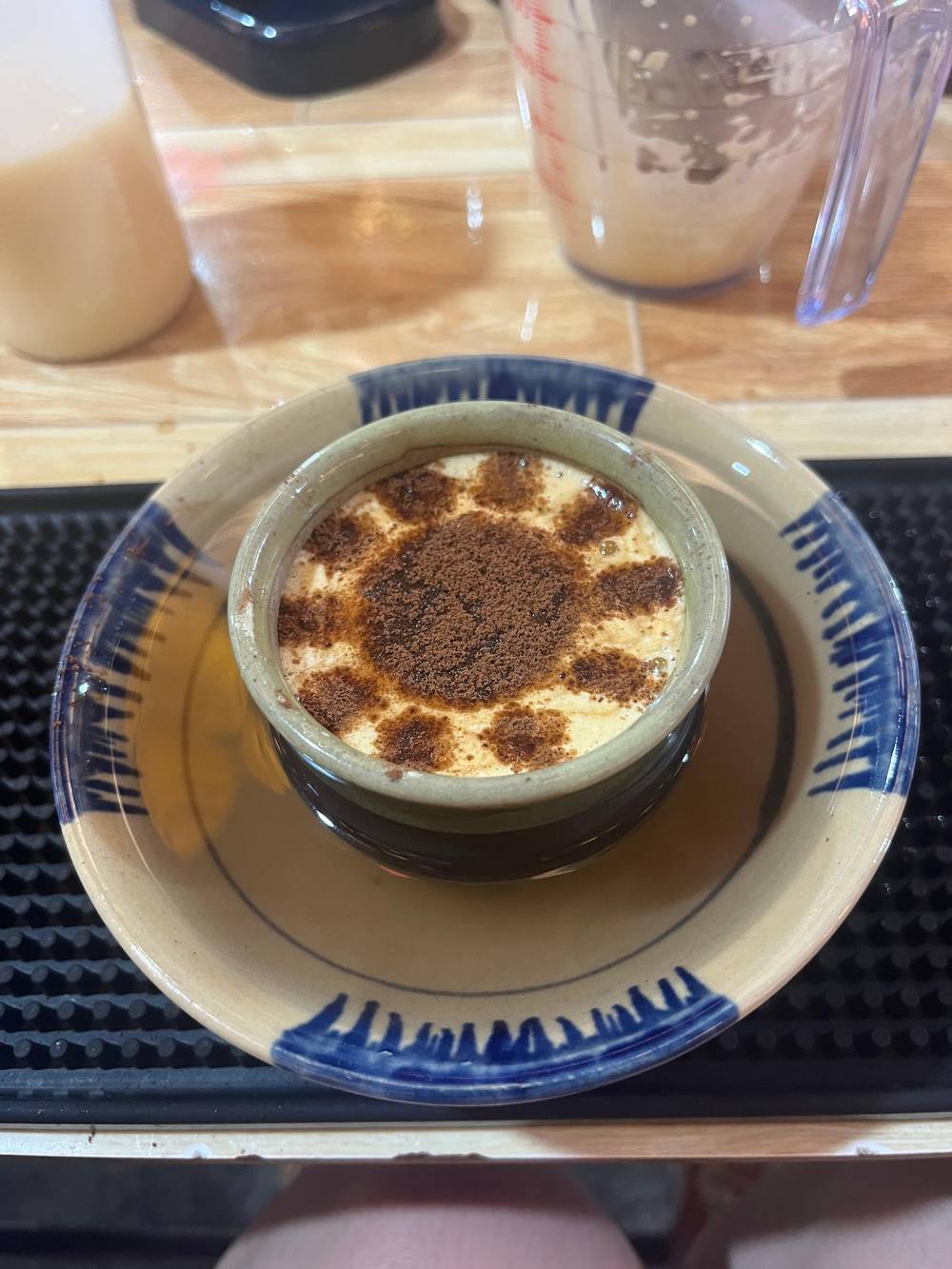
See You In Viet Nam on YouTube · The clip loads only after you tap play.
Dark-roasted robusta grounds, often roasted with butter or cocoa for a rich, nutty aroma, are steeped in boiling water.
Egg coffee is the showpiece. Egg coffee goes back to Café Giang in Ha Noi, where Nguyen Van Giang beat yolks with sugar and butter to stand in for cream when dairy ran short in the late 1940s.25 The foam sits over a strong coffee, and the authority says to fold it in gently with a spoon and sip slowly.26 A bowl of warm water under the cup keeps it hot, as Ha Noi cafes do, and that is easy to copy at home.27
From Hue comes salt coffee, a layer of salted cream condensed milk laid over robusta drip coffee, and the saline note suppresses the natural bitterness of the beans.8,28 Coconut coffee is the dessert version, built from drip coffee plus coconut milk, fresh milk and condensed milk, and it behaves more like a frozen treat than a drink.9,29 Yoghurt coffee pairs the drip with yoghurt, with condensed milk and ice as options.16
All three begin with a good phin brew, so master that first and add the extras once the base tastes right. The Hoi An class we sell includes black and white cups plus the Hue, coconut and egg specials, while the Hanoi class is all about making egg coffee yourself and learning traditional brewing. Hands-on classes cover the whisking, the proportions and the timing, which are the hardest parts to learn from words alone.
Home brewing is spreading inside Vietnam too, and not only among visitors. USDA reports a notable trend toward home brewing, with consumers buying premium robusta and arabica for modern brewing methods.30 A class gives you a head start, and the choice of classes across the country is wide, from a farm in the highlands to a cafe in the capital. The Hoi An class runs about 2 hours in English and Vietnamese, with 4 styles to make.
In Hanoi, a workshop on 4 to 6 signature Vietnamese coffees is limited to 10 participants and lasts 1 to 2 hours, and another lists salt coffee plus 5 other brews you make yourself in 3 hours. In Saigon, a beginner session of 1.5 hours has you make 3 types, with a phin filter, bạc xỉu and salt coffee among them. In Da Lat, a 2-hour workshop covers roasting, grinding and brewing at a farm.
Whichever you choose, bring a notebook and photograph the proportions and the order of the steps. Ask the instructor about the grind and where to buy beans, and take a phin home if you can. The point of a class is to repeat the experience in your kitchen, and a good one leaves you with a method you can adapt rather than a recipe you must follow to the letter, with a filter and a bag of grounds to prove it.
FAQ
There is no pressure, only gravity and patience, the tourism authority says.4
It is the classic partner, since fresh milk was scarce in tropical Indochina.12
Ice it in a tall glass of crushed ice and stir with a long spoon.13
The Hoi An class lasts about 2 hours and teaches 4 styles in English and Vietnamese.
Sources
Planning a coffee class in Hoi An? Ask a real person here.